
Secure shopping

Consumer goods and services
Consumer Goods & Retail is the largest services sector, providing the necessary link between producers and final consumers. The sector has a major socio-economic role, being among the biggest employment generators and contributors to economic growth. It is highly heterogeneous, using a variety of formats and channels to meet the needs of the more sophisticated global consumer. In today’s digital era, the increasing penetration of everyday life by information and communications technologies is reshaping the purchase decision process. This promotes the rapid development of online retail solutions that enhance customer retention and create tailor-made experience through both digital and mobile platforms.
Activities associated with Consumer Goods & Retail are the manufacturing and retailing of goods intended for everyday use by end consumers. Examples include food, textile products, apparel and footwear, household goods, furniture, hygiene and personal care products, jewellery, toys and sporting goods. It also covers all retail channels, from traditional supermarkets and specialised stores to non-store retailers such as e-stores, mail-order houses and direct selling establishments. Retail sale of fuels and vehicles is also included in this sector.
India's automotive industry is a critical component of the country's manufacturing base and economic activity. The sector contributes around 7.1% to India's GDP and approximately 49% of manufacturing GDP, reflecting its extensive linkages with ...
View more details
Malaysia has a modern consumer goods and retail sector. Malaysia's limited production capacity has made its consumer goods industry increasingly reliant on imported goods in certain segments, particularly food and non-alcoholic beverages. Malaysia ...
View more details
Brazil's retail sector started 2026 with stronger growth than in the previous quarter, although performance remained uneven across categories. According to the Monthly Survey of Trade (PMC) published by the Brazilian Institute of Geography and ...
View more details
Brazil produced 738,201 motor vehicles in Q2 2026, with light vehicles accounting for 94.7% of output and trucks and buses for the remaining 5.3%, as high financing costs and more selective access to credit constrained demand in the heavy vehicle ...
View more details
Total retail sales of consumer goods in China increased by 3.7% y/y to RMB 50,120bn in 2025, reflecting the continued expansion and resilience of the domestic consumer market. In view of the critical role of consumption in supporting broader economic ...
View more details
Brazil's automotive sector strengthened in Q1 2026, with motor vehicle production rising 5.9% y/y to 634,155 units and new-vehicle sales up 13.3% to 625,182 units, according to ANFAVEA. Growth was led by passenger cars and electrified vehicles, while ...
View more details
China's automotive sector remained the global leader in production and sales in 2025. According to statistics published by China Association of Automobile Manufacturers (CAAM), the country's total motor vehicle output and sales reached 34.5mn and 34 ...
View more details
According to the Brazilian Institute of Geography and Statistics (IBGE), Brazil's retail sector recorded a 6.4% y/y increase in nominal sales in 2025. However, much of this expansion reflected higher prices rather than stronger underlying demand, as ...
View more details
Poland has a thriving consumer products and retail sector. Polish consumers have seen a significant increase in income in recent years, driven by structurally low unemployment, rapidly rising minimum wages, and strong economic growth. The ...
View more details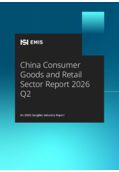
Total retail sales of consumer goods in China increased by 3.7% y/y to RMB 50,120bn in 2025, reflecting the continued expansion and resilience of the domestic consumer market. In view of the critical role of consumption in supporting overall economic ...
View more details